
Searching the Chino Valley Court Docket
Arizona Public Access is the free statewide index for Chino Valley case events and hearings. In the court field, pick Chino Valley Municipal. One catch: the local office calls itself a Magistrate Court. The statewide label trips up plenty of people. The index refreshes weekly, and it leaves out local ordinance charges. So a blank result might mean a lag. It might mean a town-code case, a name spelled differently, or a filing that actually sits in another court. For town-code matters and recently reset hearings, calling the clerk works better. The municipal clerk, not the Clerk of Superior Court, keeps the original Chino Valley city file.
- Read the Chino Valley citation for the court and citation number.
- Open Public Access, complete the CAPTCHA, and choose Chino Valley Municipal.
- Search by case year and number or by last name with known details.
- Read the newest event and hearing information.
- Call (928) 636-4534 when the date is close or the record is missing.
A case record in Public Access comes in parts. Case Information tells you the file and its status. Event Information lists dated activity, and Hearing Information gives the court date plus any result the court has entered. A blank field does not prove dismissal. The index also supplies no filed image, so if you need an actual Chino Valley pleading, order, or certified copy, ask the municipal clerk for it.
Chino Valley Municipal Search Fields
The statewide query and the local payment path pull different details from you. A Chino Valley docket search works off a party name or a case number. Paying a fine or asking for a written hearing goes through the citation number instead. The charges listed on it come along too. Keep the tasks straight. Feeding a citation into a payment screen will never pull the full Chino Valley court docket. It only shows the balance tied to that ticket.
| Field | Where used | Purpose |
|---|---|---|
| Court | Public Access | Select Chino Valley Municipal |
| Year and case number | Public Access | Find the reported docket |
| Citation number | Bond sheet or payment | Identify the obligation |
| Charges A-D | Bond sheet | List each cited charge |
| Hearing request | Written plea route | Request a not-responsible hearing |
The event history is a separate court-records matter. A receipt tells you a payment posted, but the docket still holds every filing, reset, plea, and final disposition that a payment record simply leaves out.
Chino Valley Municipal Court Basics
Start with the court itself. Chino Valley Magistrate Court sits at 1988 N. Road 1 West, Suite 401, and the office answers its phone at (928) 636-4534, with a fax line at (928) 636-1902. Its docket covers a wide mix. Civil and criminal traffic come first. Misdemeanors, juvenile and petty offenses, town-code matters, protective orders, and warrants round it out. Private civil claims stay off this municipal docket, so search elsewhere for those disputes.
Need office details or jurisdiction context? The official court source lays out what this Magistrate Court handles.
The town's published roster names Magistrate Angela Bradshaw Napper, with Ronda Apolinar serving as Administrator and Hearing Officer. Roles shift over time, so confirm any name with the town source before you rely on it for a hearing or filing.
Chino Valley Four-Day Court Week
The Chino Valley court counter keeps public hours Monday through Thursday, 7:00 a.m. to 4:00 p.m. Friday is dark. That sets it apart from other Yavapai County offices, and a Friday trip can end at a locked door. Before you drive over for anything tied to a hearing or deadline, call the clerk; the fax line works too.
Timing point: Confirm Chino Valley hours before a visit. The four-day municipal schedule does not match the county Clerk's ordinary weekday pattern.
The four-day court week reaches into payments too. A drop box takes approved after-hours papers, but cash belongs nowhere near it, and cash should never go through the mail either. Label anything you file with the Chino Valley case number so the clerk knows where it belongs.
Checks and money orders work by mail. Card payments by phone stay limited to the cardholder under the published process. With fewer business days in the week, a slip-up leaves less time to correct, so settle on your route before a Chino Valley deadline gets close.
Court Dates and Settings in Chino Valley
Chino Valley runs a weekly calendar with real precision. Monday brings orders to show cause at 1:30 p.m., open court from 2:00 to 3:00, and civil traffic hearings at 2:00 or 2:30. Tuesday holds criminal arraignment at 8:30, orders to show cause at 10:00, and civil arraignment at 10:30. Wednesday carries criminal pretrial conferences at 9:00 and bench trials at 1:00. Treat these as recurring patterns for the court docket, not promises for any single case.
| Date | The current Chino Valley setting date. |
|---|---|
| Time | The individual time or weekly docket block. |
| Courtroom | The municipal location in the current notice. |
| Judicial officer | The magistrate or hearing officer assigned. |
| Setting type | Arraignment, open court, pretrial, bench trial, or OSC. |
| Result | The entered outcome; blank may be future or pending entry. |
Defendants in criminal, criminal-traffic, and petty cases set for 8:30 must show up. Juveniles appear with a parent or guardian. For your own court dates, confirm the specific Chino Valley docket instead of trusting the weekday pattern alone.
Chino Valley Hearing Time Differences
Two Tuesday blocks exist in Chino Valley court, and they cover different case types. Anything criminal, criminal traffic, or petty that requires you to appear gets an 8:30 time. Civil traffic sits at 10:30, and appearance is required there too. One exception applies: if you paid the ticket or finished defensive driving under the court's rules, you are done. Mixing up the two times is a common way to miss a Chino Valley hearing, so check your notice closely before you plan the drive.
- Arraignment
- The event where a charge is stated and a plea is addressed.
- OSC
- An order-to-show-cause setting that asks why a prior order was not followed.
- Pretrial conference
- A setting used to narrow issues and prepare the next case step.
- Bench trial
- A trial decided by a judge rather than a jury.
The most recent court notice always wins. If your case was reset, confirm the new date with the clerk. The statewide case index can lag behind the change. It may still show the old setting.
Monday open court is a local option, not a standing walk-in right for everyone. Someone scheduled for Tuesday criminal arraignment cannot simply swap in a Monday appearance without approval. Wednesday is different again. The pretrial and bench trial dockets serve separate phases of a case. In every instance, trust the label the Chino Valley docket gives you.
Traffic Tickets in Chino Valley
Paying a Chino Valley traffic ticket is flexible. The town takes cash, check, or money order at the window. Mail works too, though only by check or money order. Cardholders can pay by phone, use AZCourtPay, or go through nCourt's branded ticket route. There is also a front drop box for after hours. Never put cash in the mail or the box. Remember that paying responds to the case. It does not pull up the rest of the Chino Valley traffic docket.
Fees follow a set pattern. Each citation carries a $40 court administrative fee. A $15 traffic processing fee applies too, charged per citation rather than per violation. Leave an authorized balance unpaid past the court date. A $20 time-payment fee can apply. Other published charges kick in only when their service is triggered. The town's official cost source sets out the full fee table.
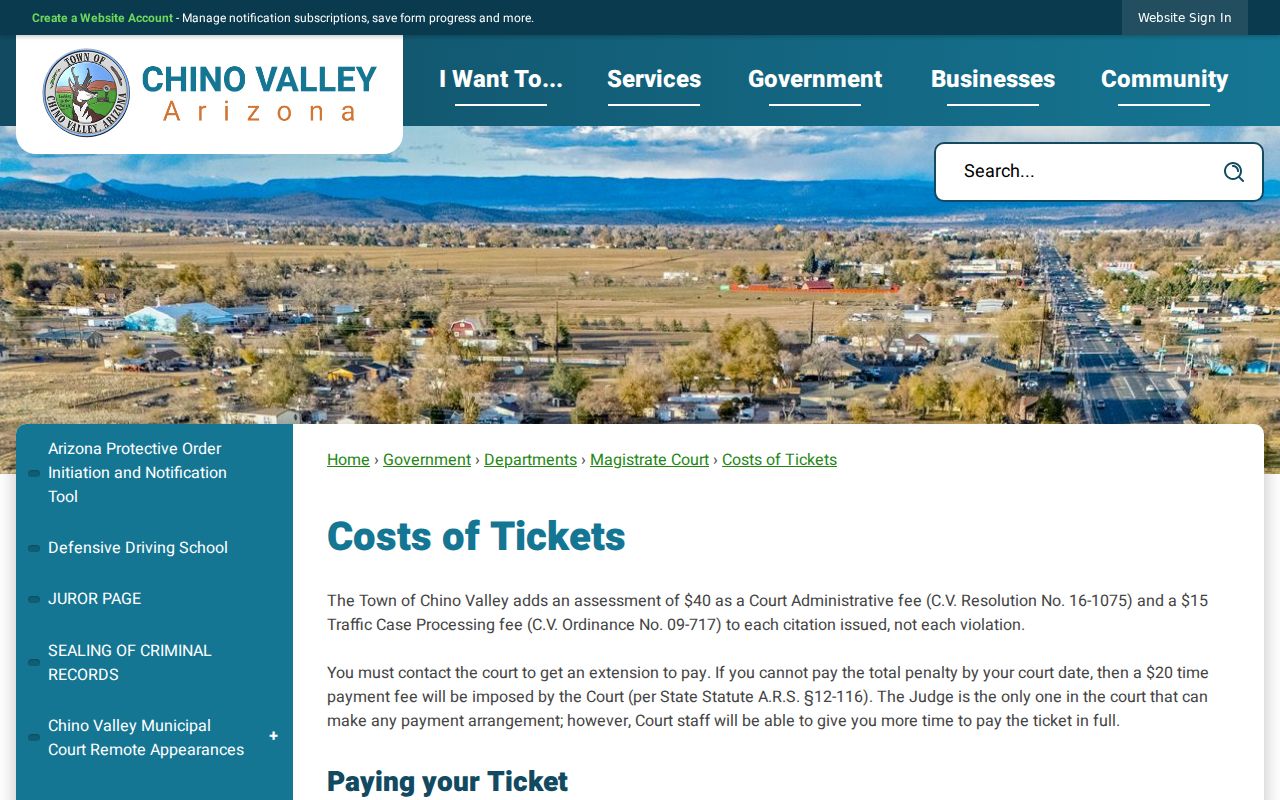
Which Chino Valley fees attach to your citation? Ask the clerk. A municipal schedule lists every possibility, but one case rarely triggers them all.
Chino Valley Not-Responsible Pleas
Contesting a civil citation takes an affirmative step. Chino Valley's official material says to appear in court and file a written Not Responsible plea, which prompts the court to set a hearing. Merely not paying requests nothing. The bond schedule backs up the written route with the citation number, up to four charge lines, a hearing-request choice and signature, fee lines, and a running total. That form does the asking for you.
- Read each cited charge and the appearance date.
- Use the court's written not-responsible choice or appear as directed.
- Sign and supply the citation identifier.
- Wait for the court to set the Chino Valley hearing.
- Confirm the date directly before appearing.
Criminal traffic is different: arraignment may be required, and a civil plea cannot substitute for a mandatory criminal appearance.
Where Chino Valley Cases Go
Where a case lives depends on its type. The Chino Valley municipal clerk keeps town traffic, misdemeanor, code, protective, warrant, and other authorized limited records. Nonmunicipal civil matters usually head to the Prescott Justice precinct or Superior Court. It depends on claim type and dollar limit. Felony, family, probate, juvenile, mental-health, and major civil cases all sit at the Superior Court level.
Docket flow: Chino Valley Magistrate Court › Prescott Justice Court › Superior Court of Arizona in Yavapai County
Appeals split the record. A municipal appeal opens a new Superior Court appellate docket, yet the Chino Valley clerk keeps the original file. The county-level case lookup can find that later number. It does not replace the municipal record.
Chino Valley Defensive Driving Record
Defensive driving has a price and a rulebook. The state table puts the Chino Valley subtotal at $204 effective April 1, 2026, with private school tuition on top. Eligibility is local: one eligible moving charge only, no Arizona defensive-driving course for another violation in the prior 12 months, no hearing already set, completion before the deadline, no death or serious-injury collision, and the commercial-license limits that apply. The town's defensive-driving source explains the local process.
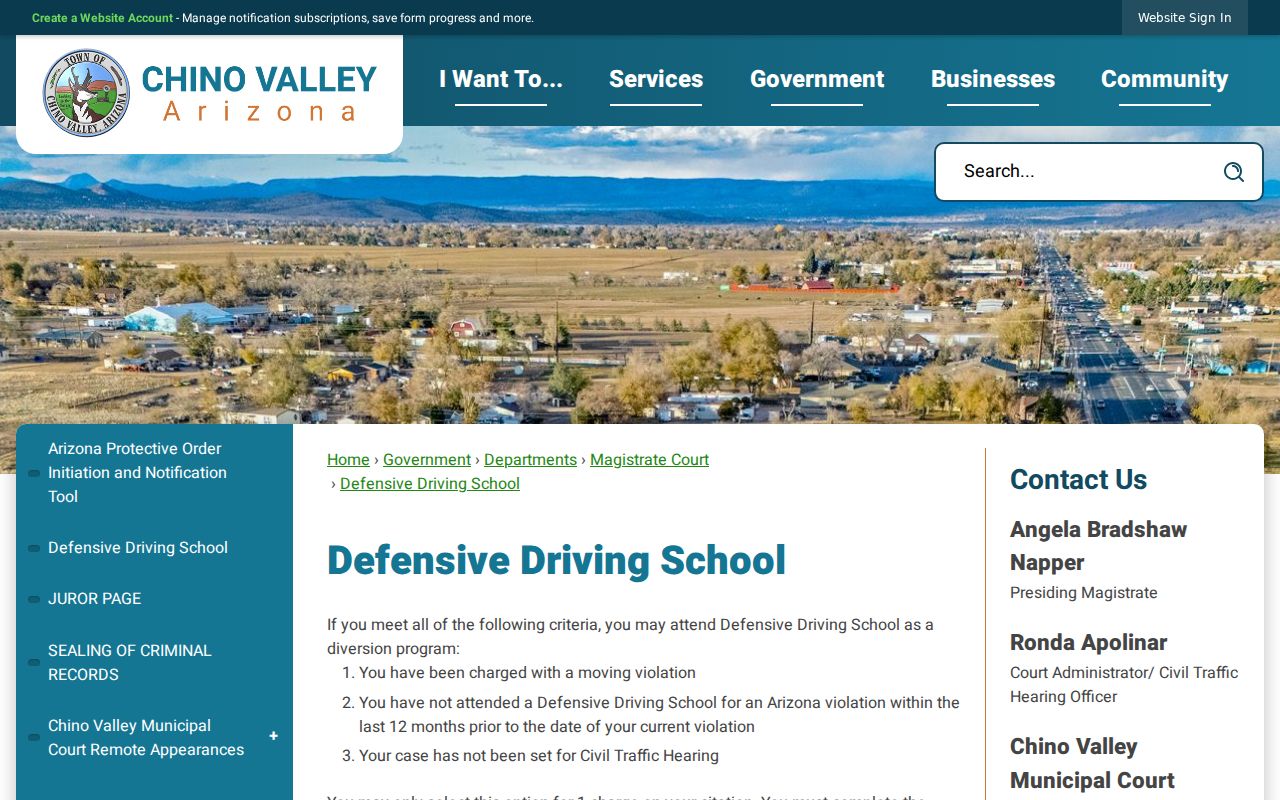
The state chart also allows a possible 30-day continuance, court-approved. Approval matters. A driver cannot tack on 30 days without an order, and school completion must reach the court through the proper channel.
Chino Valley Court Record Access Rules
Access rules shape what you see. Arizona Supreme Court Rule 123 governs judicial-record access, and Public Access leaves plenty out. Sealed matters are excluded. So are local ordinance charges, protection orders, victim and witness information, mental-health and probate cases, and juvenile delinquency. Personal identifiers get redacted as well. So a blank Chino Valley result does not prove no filing exists.
Key rules:
Arizona Supreme Court Rule 123 sets the judicial-record access framework and protects closed material.
A.R.S. § 39-121.01 addresses public-record preservation and prompt copies, subject to court-specific rules.
A.R.S. § 8-208 restricts access to named juvenile records.
Copies carry published costs: $0.50 per page, plus possible $17 research, clerk, duplication, or certification charges. Confirm which service triggers a fee before you order.
Chino Valley Three-Clerk Routing
One town, three clerks. A Chino Valley event can land with any of them. The municipal clerk holds town cases. The Prescott Justice Court clerk holds justice-level matters in the precinct. The elected Clerk of Superior Court holds general-jurisdiction and municipal-appellate files. Calling the wrong office delays your request, even when every fact arose in Chino Valley.
| Record type | Custodian |
|---|---|
| Town citation or code case | Chino Valley municipal clerk |
| Small claim, eviction, qualifying limited civil | Prescott Justice Court clerk |
| Felony, family, probate, major civil | Clerk of Superior Court |
| Municipal appeal | Original city clerk plus Superior Court appellate clerk |
Send the court caption and number, not just a place name. Geography alone never decides record custody.
A blank statewide search deserves one retry. Repeat it with the other plausible court, but only if the case type supports that route. Then call the named clerk. This ordered check beats mailing the same broad request to all three offices. It also preserves the real differences among municipal copy fees, justice procedures, and Superior Court records.